CIPC Steps Up Compliance Checklist Enforcement.
The Companies and Intellectual Property Commission (CIPC) has intensified its enforcement of statutory compliance through a renewed focus on the Compliance Checklist, signalling a firmer regulatory stance toward companies, close corporations, and non-profit organisations. This initiative forms part of CIPC’s broader mandate to strengthen corporate governance, transparency, and accountability within South Africa’s business environment. The Compliance Checklist requires entities to confirm adherence to key legislative obligations, including the submission of annual returns, the accuracy of director and company contact details, and compliance with applicable provisions of the Companies Act and related regulations. CIPC has made it clear that inaccurate, incomplete, or misleading checklist submissions will be regarded as non-compliance rather than minor administrative oversights.
A significant development is CIPC’s stated intention to publish the names of non-complying entities. This introduces a heightened level of reputational risk for businesses that fail to meet their statutory obligations and represents a shift from a predominantly educational approach to one of visible enforcement. The objective is to promote voluntary compliance while discouraging persistent disregard for regulatory requirements.
This enforcement drive is supported by CIPC’s ongoing digital modernisation programme, which includes improved online platforms and case management systems. These tools enable closer monitoring of compliance patterns and allow for more efficient regulatory intervention. As reliance on physical service centres continues to decline, digital records and electronic submissions now form the primary basis for compliance assessment.
For directors, trustees, and professional advisers, the message is clear: the compliance checklist is no longer a routine “tick-box” exercise. It constitutes a formal declaration with potential legal and reputational consequences. Entities are therefore encouraged to review their statutory records carefully, ensure consistency across all filings, and address any historical non-compliance proactively.
In an environment of increasing regulatory scrutiny, accurate completion of the compliance checklist has become an essential element of corporate risk management rather than a procedural formality.
What COP30 Means for South African Companies and SMEs.
The latest global climate summit, COP30, confirmed a shift that South African businesses are already experiencing: climate change is no longer just a policy issue—it is a commercial one. The focus has moved from long-term targets to implementation, resilience and capital flows, with direct implications for companies of all sizes. One of the strongest signals from COP30 was the push to scale climate finance, particularly for infrastructure, energy resilience and adaptation. For South African SMEs, this means funders and banks are increasingly linking finance to basic sustainability and risk-management practices. Businesses that can show awareness of energy use, water risk and operational resilience will be better placed to access funding and insurance.
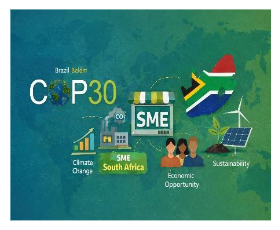
Although COP30 did not impose new global rules on fossil fuels, the direction is clear. Energy transition pressure is coming from markets, customers and costs, not just regulation. In South Africa, where load shedding and rising energy prices already affect productivity, solar, backup systems and energy efficiency are becoming competitive advantages, not optional extras.
The summit also reinforced the importance of nature, water and land use. For South African sectors such as agriculture, food processing, tourism and property, environmental risks directly affect operations, supply chains and community relations. Water security, land stewardship and responsible sourcing are now business-critical issues.
Adaptation featured strongly at COP30, recognising that climate impacts are already here. Flooding, heat stress, drought and insurance costs are increasingly shaping business continuity planning. Companies that fail to plan for physical risks face higher costs and operational disruption.
Finally, transparency expectations are filtering down the value chain. SMEs may not need formal ESG reports, but they will increasingly be asked to explain what they are doing and why.
The key takeaway: sustainability is no longer about image or compliance. For South African businesses, it is about resilience, risk management and long-term viability.
King V: Key Implications for Company Directors.
A New Chapter in South African Corporate Governance.
South Africa’s corporate governance framework has entered a new phase with the introduction of the King V Report on Corporate Governance. Issued by the Institute of Directors in South Africa, King V replaces King IV and applies to financial years beginning on or after 1 January 2026. The updated Code responds to growing expectations around ethical leadership, sustainability, technology governance and accountability. King V retains an outcomes-based philosophy, focusing on ethical culture, good performance, effective control and legitimacy. It streamlines governance principles and places greater emphasis on measurable outcomes rather than procedural compliance. Integrated thinking is elevated to a core board responsibility, requiring directors to consider the interconnected impact of strategy, risk, sustainability, financial performance and societal outcomes.

One of the most significant implications for company directors is the strengthened focus on board independence and effectiveness. King V introduces clearer guidance on director tenure, cooling-off periods for former executives, and more rigorous assessments of independence. Boards are expected to demonstrate that they are appropriately composed, diverse, skilled and capable of objective decision-making.
Disclosure expectations have also been enhanced. Directors must ensure that annual reports clearly explain how governance principles have been applied and provide meaningful explanations where practices differ. Generic or boilerplate disclosures are no longer sufficient under the new governance framework.
In addition, King V significantly elevates the board’s responsibility for environmental, social and governance matters. Oversight of climate risk, social impact, transformation, data governance, cybersecurity and emerging technologies such as artificial intelligence now fall squarely within the board’s mandate.
For company directors, King V represents both a challenge and an opportunity. Proactive alignment with the Code will help boards build trust, strengthen resilience and support sustainable long-term value creation in an increasingly complex business environment.
Appointment of New SARS Commissioner.
Dr Ngobani Johnstone Makhubu Appointed as New SARS Commissioner.
In a landmark move for South Africa’s tax administration, President Cyril Ramaphosa has announced the appointment of Dr Ngobani Johnstone Makhubu as the new Commissioner of the South African Revenue Service (SARS), effective 1 May 2026. Dr Makhubu succeeds outgoing Commissioner Edward Kieswetter, whose tenure is widely credited with restoring SARS’s operational strength and reputation after a period of turbulence.

With a distinguished career in tax administration, Dr Makhubu previously served as Deputy Commissioner: Taxpayer Engagement and Operations since May 2023. Known for championing digital transformation and compliance initiatives, Dr Makhubu has played a pivotal role in expanding SARS’s auto-assessment program and enhancing taxpayer engagement through innovative digital platforms.
The appointment comes at a time when SARS has achieved a historic milestone, surpassing R2 trillion in net revenue collection for the 2025/26 financial year. This achievement, the highest in South Africa’s democratic history, reflects improved compliance, administrative efficiency, and resilience amid economic challenges. The tax-to-GDP ratio now stands at 25.9%, underscoring SARS’s critical role in national fiscal stability.
President Ramaphosa’s selection of Dr Makhubu signals a commitment to continuity and innovation. The new Commissioner is expected to intensify efforts to disrupt the illicit economy, prioritize anti-corruption measures, and further modernize SARS’s operations. Stakeholders anticipate that Dr Makhubu will build on the foundation laid by Kieswetter, ensuring SARS remains a cornerstone of South Africa’s economic recovery and growth.
As Dr Makhubu steps into this leadership role, the nation looks forward to a new era of tax administration marked by transparency, efficiency, and robust compliance.