2026 National Budget Speech.
The South African Government has officially announced that the 2026 National Budget Speech will be delivered by Finance Minister Enoch Godongwana on 25 February 2026.
In the lead-up to the speech, Minister Godongwana is calling on citizens, business leaders and civil society to submit concise budget suggestions that could help inform the government’s fiscal priorities. South Africans are encouraged to share their views on a range of issues – from spending priorities and tax policies to debt sustainability and financing for energy, water and municipal services.
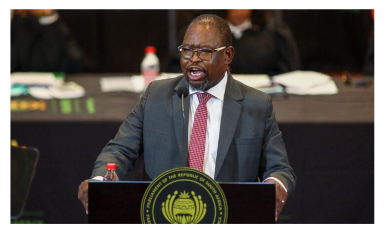
The call for input is part of a broader effort to make the budgeting process more inclusive, giving everyday people a chance to influence how public resources are allocated in a year marked by continued economic pressures and inequality. Contributions should be no longer than 300 words and must be submitted by 16
February 2026 via the National Treasury’s Budget Tips portal.
Participants can also engage with the process through social media by tagging their ideas with #TipsForMinFin and #Budget2026, broadening the conversation about South Africa’s fiscal priorities.
This year’s budget comes amid widespread public interest in issues such as balancing economic growth with support for vulnerable communities, addressing the persistent budget deficit, and strengthening the performance of state-owned entities. By inviting input from the public, the Treasury aims to ensure that the final Budget Speech reflects a diversity of perspectives to help shape South Africa’s fiscal
roadmap for 2026.
South Africa Exits EU High-Risk Finance List – A Milestone in Global Financial Confidence.
South Africa has achieved a significant milestone in its financial governance journey with its removal from the European Union’s list of High-Risk Third Country Jurisdictions, a designation that took effect on 29 January 2026. The announcement was welcomed by the National Treasury, which highlighted the development as a positive step for reducing barriers to international financial engagement.
The EU list identifies countries with strategic deficiencies in their systems for combating money laundering and terrorism financing. These criteria are designed to protect the integrity of the EU’s internal financial markets. South Africa was added to this list in August 2023 after being placed on the Financial Action Task Force (FATF) greylist, which signals elevated risk and requires enhanced scrutiny on financial transactions involving the listed jurisdictions.
Treasury officials say the EU’s decision reflects substantial improvements in South Africa’s anti-money-laundering and counter-terrorism financing (AML/CFT) frameworks, including strengthened regulatory controls and more comprehensive systems to track and prevent illicit financial flows. The move follows South Africa’s exit from the FATF greylist and similar removal from the United Kingdom’s high-risk list in October 2025.
Under EU rules, inclusion on the high-risk list had compelled EU financial institutions to apply enhanced due diligence, including more intrusive checks, additional documentation, and higher-level approvals on transactions involving South African entities. This added substantial cost and administrative friction to cross-border trade, payments and investment. The delisting therefore brings potential long-term benefits for international trade and investment flows.
Despite the positive development, the Treasury stressed that work remains to be done to further strengthen South Africa’s AML/CFT regime, particularly in the areas of investigation and prosecution of financial crimes. The country is preparing for a new FATF evaluation round, with the final report expected by October 2027, using lessons learned from the recent successful exit from greylisting.
South Africa Showcases Economic Reform Progress at Davos 2026.
South Africa’s National Treasury, led by Finance Minister Enoch Godongwana, played a prominent role at the 2026 World Economic Forum (WEF) Annual Meeting in Davos, Switzerland, from 19–23 January 2026, using the global stage to highlight the country’s economic reform achievements and growing investment potential.
Under the forum theme “A Spirit of Dialogue,” Team South Africa, comprising Cabinet ministers, industry leaders, and senior government officials, engaged with global investors, potential partners, and international organisations to underscore the progress made since the previous year. According to the National Treasury, this was not merely a reiteration of plans but a presentation of measurable results.
Minister Godongwana emphasised that South Africa returned to Davos “not with promises, but with real successes,” drawing attention to key milestones such as the nation’s removal from the Financial Action Task Force (FATF) greylist, an upgrade of its sovereign credit rating by S&P Global, and structural reforms under Operation Vulindlela that have stabilised the electricity supply and improved logistics infrastructure. These achievements, the Treasury said, signal stronger macroeconomic stability and enhanced investor confidence.
In engagements and panel discussions, the delegation highlighted the government’s commitment to stabilising public debt within the current fiscal year, lowering the inflation target to ease costs across the economy, and providing consistent policy execution – all designed to create an environment more attractive to both local and international capital.
A Davos press conference also provided a platform for Team South Africa to reflect on its 2025 G20 Presidency, a milestone that culminated in a historic G20 Leaders’ Declaration and reinforced South Africa’s role in global economic cooperation.
Through strategic dialogue, high-level meetings and investment-focused showcases, the Treasury affirmed South Africa’s commitment to structural reform, macroeconomic credibility and inclusive growth – key messages aimed at sustaining momentum and broadening global partnerships in 2026 and beyond.
South African Reserve Bank Holds Repo Rate as Inflation Eases and Growth Steadies.
At its first policy meeting of 2026, the Monetary Policy Committee (MPC) of the South African Reserve Bank held the repurchase (repo) rate steady at 6.75%, maintaining a cautiously neutral stance in the face of global and domestic economic uncertainties. This decision, effective from the January 29 meeting, reflects a backdrop of easing inflation and stabilising growth, but also persistent risks in the external environment.

The Governor noted that headline inflation stood at 3.6% in December 2025, slightly above the central bank’s 3% target, though the committee believes this represented a cyclical peak and expects inflation to slow further as the year progresses. Broadly, inflation last year averaged 3.2%, close to the Bank’s objective. Core price pressures remain modest, supported by a stronger rand and lower global oil prices, although inflation in services remains elevated.
Economic growth in South Africa has shown encouraging momentum, with four consecutive quarters of expansion, a run not seen since 2018. Household consumption has been the primary growth driver, while business investment has been more erratic. The MPC’s forecasts suggest growth could approach around 2% over the medium term, contingent on sustained investment recovery.
On global developments, elevated geopolitical tensions, large external imbalances and uncertainties in financial markets continue to challenge central banks worldwide. This underscores why the MPC chose caution in its rate stance. A majority of members voted to hold rates, with some favouring a future cut should inflation expectations continue to soften.
Looking forward, the SARB anticipates gradual easing of inflation and stands ready to adjust policy on a meeting-by-meeting basis, with its next policy decision due on 26 March 2026.